Are you someone who can accept compliments? If so, you are a rare jewel.
Since October 2019, I have stopped coloring my hair. It’s neither a statement about some anti-establishment view of chemicals and cancer, nor an invitation for others to join in my journey. I simply decided that it didn’t feel “like me” to continue dyeing my hair. So I stopped.
This caused some of my friends (and even my 79 year old mother) to get very defensive about their own hair. From comments like “it looks good on you, but I could never do that” to my mother’s statement “I’m going to my grave with a color, wash and set”, it has provoked some pretty strong feelings. It also has received some unsolicited compliments, especially from strangers.
I recently went into a CVS and the woman behind the register said, “your hair looks so cool!” Interestingly enough, I found myself replying, “oh, well, just another excuse to leave the house quicker.” I discounted the compliment by excusing it away. Which, in retrospect, makes me think of all the ways I have expertly refused to accept a compliment.
The most frequent way is by deflecting. This happens to me especially after performing in a play, when I am coming out to greet the audience. Someone will say, “you did a great job,” to which I will say something like, “if only I could actually get all the words out” or “you should have seen it last night. It was so much better”. How rude, Lee! It actually is technically an insult to the complimenter. I’m currently reading David Mamet’s True and False, and this act of deflecting, according to him, is possibly the most selfish thing a performer can do. And, you know, he isn’t really wrong.
Why is it so difficult to accept a compliment? Why is it so inherent to our nature to find any response to one other than a simple “thank you.”? I’ve tried to just be grateful, but the closest I get is to reciprocate and compliment the other person. Say, my sister-in-law comes to my house for dinner, and compliments my chicken dish. My response would be “well, it’s nothing compared to your amazing roast chicken.”
We make such an effort to dance around the gratitude that others gift to us, that we should all have the metabolism of a hummingbird. And yet, what does this say about our fragile psyche that we are so willing to shower others will praise, yet refuse to absorb, let alone accept, others expressions of gratitude towards us?
I’m going to try to really hear a compliment when it is gifted to me, and look the person in the eyes, smile, and simply respond, “Thank you”.
I came across a fascinating tale a while back about a garden designer who set up a disconnected telephone booth in a public field in Japan, where people can “call” people who have died, and say whatever they want. Entitled “Kaze no Denwa”, or the Phone of the Wind, the artist, Itaru Sasaki, created this installment shortly after the Great East Japan Earthquake of 2011, to honor his cousin, who perished.
I first heard about this phone booth in an episode of the podcast This American Life entitled “One Last Thing Before I Go“, which talks about people who are making one last effort to communicate with their loved ones. It was almost two years ago that the episode aired, but I’ve been thinking a lot about what is said, and left unsaid, between loved ones.
My mother will be turning 79 on March 12, 2020. She has been spending the better part of the last few months organizing and preparing her final wishes: funeral, cemetery plot, financial planning, etc. She isn’t ill, so don’t get sad. In fact, it has only been through my persistent, yet gentle, insistence for the past two years that she is finally (hallelujah!) getting her affairs in order.
I’m sure the subject weighs heavy on her. After all, what is the fun in preparing for your death. But, until we began this process, I had no idea just how much is involved. I know many friends whose loved ones did not make these preparations in advance, and the torture they went through to sort it all out after their death.
But it is not the knowledge of death that spurs me to write this. It is a recurring theme that I have felt about how little we express to others about ourselves: our hopes, fears, wishes. Sure, we vague-book, and occasionally rant on social platforms. But how many people can you honestly say truly knows everything about you? Would it be safe to say that there is actually no one?
In my case, that is true.
I am definitely a sharer. Sometimes an over-sharer. But in retrospect, my sharing is of the mundane, the superficial. I can maybe think of one person with whom I have shared some of the feelings and thoughts I have in my head. But even that person doesn’t know everything.
So, would it be safe to say that, if we don’t share ourselves with others, that indeed we truly don’t know anyone with any degree of depth? Why do we wait until the other person is gone and can only be reached by a non-working telephone to share our innermost thoughts, our feelings, our wishes and regrets?
American culture dictates that we walk in silos, that we share only when necessary, and only as little as is needed to communicate our intent. And I think that’s crap, and only isolates us as humans.
Obviously I am not the only one who struggles with this dichotomy. There was a book released in September 2019 called “Before The Coffee Gets Cold” and a film that was just released in January 2020 called “Voices in the Wind” about this theme.
I don’t want to have any regrets at the end of this journey: no bucket list items left unchecked. But, more importantly, nothing left unsaid. So, I’m gonna start sharing, people. You have been warned.
Which leads to to the questions: is there someone you share your inner-most thoughts and feelings with? Do your loved ones know exactly how you feel?
I have never been a fan of horror movies, true crime, or gore. I don’t like being scared or startled. But recently, I’ve actually gone out of my way to avoid it. To shelter myself from it.
My husband is a fan of horror. He and his sister can have casual conversations about programs she watches about real live serial killers that live next door to unsuspecting people. He talks about articles he reads of people butchering each other, Their mouths are agape, but I get the feeling a piece of them actually gets a thrill from it.
Another example: my husband is a HUGE fan of “The Walking Dead”. I watched the first episode, and after the second instance of blood spurting, I gave up. I can’t even sit in the room when he watches it, because the “wet sounds” actually make me gag.
I used to be able to watch programs like “Nip/Tuck” and “Criminal Minds”, maybe because a part of me was interested in the character development and story. But recently, I actually have to leave the room if these things are on.
I am a very visual person. So much so that, even a few minutes of obviously fictionalized violence can play havoc with my dreams. The best example of this was a long time ago, there was a commercial for a movie called “Saw”. My husband explained the premise to me, and that night I had a vivid dream.
In the dream I remember waking up with a pounding headache on a dilapidated sofa, and, looking to my right, saw a gouged-up coffee table with a knife laying on top of a hand-scribbled note that said “turn on tv”. I look over, and see a small black and white tv on the far end of the table. I turn it on, and, at first, the reception is fuzzy, and then it slowly clears and I see what looks like CCTV of my dog Ivan, strapped down on a metal table, his paw on a butcher block and a cleaver beside it. A gloved hand holds up a white card in the screen view that says “your pinkie, or his paw”. I then see the gloved hand put the card down, and lift the cleaver. Another gloved hand grabs Ivan’s paw and holds it tight on the butcher block. Ivan begins to whine. I realize that, in order to save my dog’s paw, I have to be willing to sacrifice my pinkie. And, for a moment, I am frozen, because I’m not sure I can cut off my own finger. And, as if someone could see me hesitate, the gloved hand holding Ivan’s paw jerks his arm and raises the cleaver again and Ivan yelps. I burst into tears and scream…
…and woke up in a sweat, crying my eyes out.
Now, that was from my husband explaining the premise of a horror film to me. The premise being: how much pain are you willing to sacrifice to save another, and how much pain are you willing to inflict to save yourself?
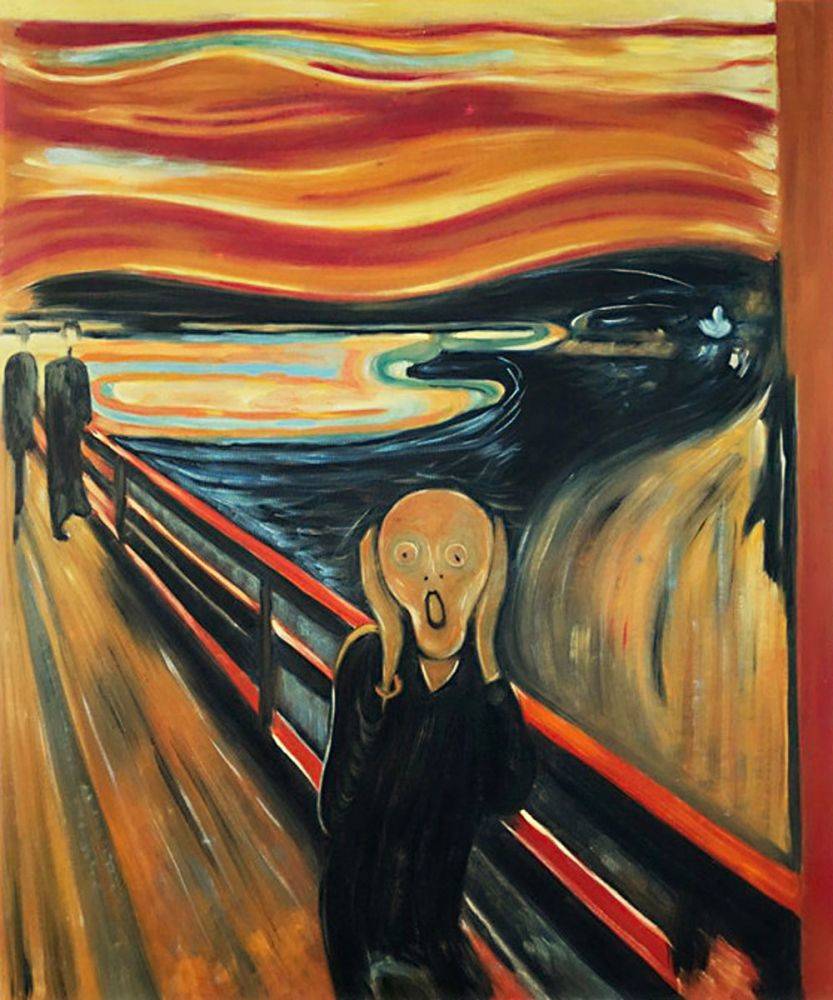
The most famous scream of them all…
That was years ago, and Ivan is long gone, but the day we brought him to the vet to give him some peace from his pain, I thought to myself, “I would cut off my hand if I thought it would make you better, and keep you alive.” It was that haunting of a dream that, even on his death bed, I remember my indecision.
Having said all that, I do like murder mysteries. But I like the English ones where they don’t show blood and are just slightly melodramatic. Ones that give a bit of a wink to the fact that they are manufactured. I love “Murder She Wrote” for that reason. And all Conan Doyle and Agatha Christie. They made you think, but they didn’t spook you with the violence. “Columbo“, too. And I like books by Tamar Myers and Janet Evanovich that touch upon the theme, but only in a “cuddled-in-a-comforter-sipping-tea-with-a-cat-in-your-lap” kind of way.
I wonder what has made me so extra sensitive to violence and horror and gore, lately. It’s one of the main reasons I stopped watching tv a year ago. And why I pick my viewing content with streaming media very carefully.
Are there things you just can’t be around? What brings you comfort?
Technology has given us mere mortals an extended view of world events, opinions of the masses, and access to information we were previously unable to review without a great deal of time and effort. But one thing it seems to have done is isolate us into silos of existence. We spend a large sum of our daily waking time attached to technology, seeking information, entertainment, and ironically, companionship where there might be none.
The drawback of access to all this is that we seem to have lost the ability to communicate with each other in person. I recently watched an episode of a series (OK, it was Star Trek Picard – I’m a nerd) and there were two people, in what looked like a cafe, having a conversation. Not holding cell phones while sitting beside each other. Just two people, background sounds, drinks (ok, probably a bar) and one another. Talking. Having a real conversation. Not platitudes about the weather. Not even discussions of life and death and impending interplanetary destruction (which you always casually discuss while having drinks in a bar/cafe). A conversation about feelings, and beliefs, and examples from life. Two human beings connecting.
Eric Hall “The Art of Conversation”
And that seemingly irrelevant discussion in a random sci-fi tv show (albeit MARVELOUS tv show) made me stop and think: when was the last time I had a truly human conversation, in person, with someone?
And I had to pause. And think. And think some more.
Before I could actually come up with an example, I was taken back to my childhood. I would go to the local park, and my babysitter (not my mother) would be sitting on a bench, talking with other adult guardians, while the kids were left to their own devices. Many a heated and heartfelt discussion would be held at those benches. World events, politics, religion, were common topics. Lighter fare like recipes, disciplinary considerations for their charges, family and feelings were also present. In those days, I often stopped playing, and would sneak up behind the grownups, and sit behind the benches, listening. I wanted to be a part of these conversations. I wanted to feel that sense of inclusion. But I always sat apart.
That was, perhaps, my earliest memories of these types of conversations. Others seem to crop up: kids waiting for the bus talking about teachers; sitting around the lounge area of the theater building at college, talking and laughing (and smoking) and sharing. Actors in a green room, after the weeks of work and strategy were set, finally bonding and learning about each other as humans. Those are my connections today.
I didn’t grow up having the daily call to grandma, or the weekly call to some other relative. I bring no regular habits of person to person communication with me from childhood. I have formed no process to regularly check in with my people. In fact, I often go weeks and forget to even call my mother. I’m just not wired that way.
“Conversation” by Mihaly Munkacsy
I have been part of these larger conversations, and am fascinated by the insightful and caring questions that others ask to one another, to better understand the person and their conversation. I marvel sometimes and say to myself, “oh, that’s a good question. Why didn’t I think to ask that?” I see how effortless this is for other people. And how foreign it feels to me. When I participate, I fee as though I am in a spotlight and am required to amuse, and story tell, but it doesn’t feel like sharing. I’m talking at, not with, the others.
And yet, lately, I feel this need, this calling to be connected, to understand another person’s narrative, to glean perspectives about my experiences and feelings and opinions by talking with other people, but in a non-technological way. But I simply don’t know how to begin. As extroverted as I am, I am a socially-awkward live-communication hermit: I skulk behind blog posts and social media, and listen, but feel no connection to others. I want to know how to meet someone for coffee and kibbutz; I want a sister or friend that I just talk to in person regularly to learn more about them, understand them better, and maybe, in the process, understand myself and my place in the universe a bit more.
I want to stop living my life at arm’s length from everything: armed with technology to act as a physical and emotional barrier from truly making connections and understanding the people that make up the world around me. But how to begin?
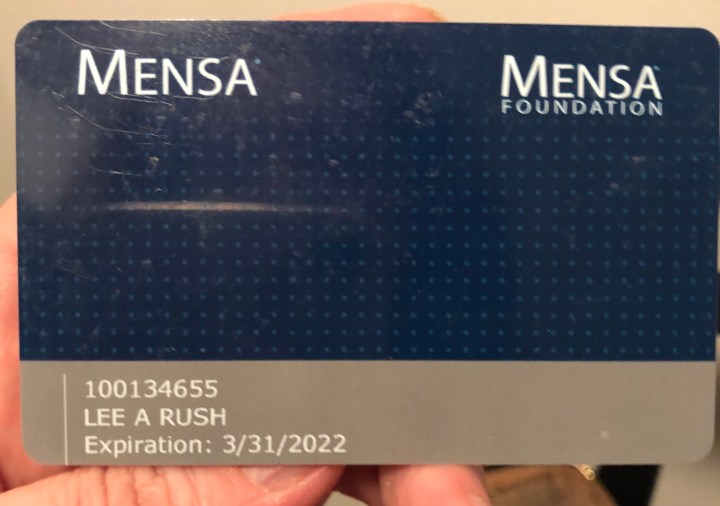
You can call me many types of names, and, on most, I won’t disagree, or even put up a fight. But one thing you cannot call me is stupid. In fact, I actually belong to an organization called Mensa, which purports to carry a membership of people in the top 2% of intelligence in the world.
To be totally and completely honest, I have never done anything with this membership. I’ve not attended a meeting, nor a social event. I’ve not voted or even interacted (knowingly) with any member. Nor have I (surprisingly enough) used my Mensa card for bragging rights. Less interesting is the fact that I am in Mensa, but the reason why I joined in the first place. And it was simply an act of revenge.
About 20 years ago, I dated someone that wasn’t exactly present in the relationship. He wasn’t abusive, he was absent. I served a limited purpose to him, and that was enough for him. He also once said, in not so many words, that I was too stupid to understand his job.
The day after we broke up (which wasn’t long after that comment), I began my plan of revenge. First, I researched and found the next testing date for Mensa in Rhode Island, and, after a two week wait and a three-hour test, was quickly accepted. Upon receipt of my card from the organization, I promptly took a photo and sent it to my ex.
Next, I took a course on how to “do what he did for a living” (some form of computer web programming that was far too dull to recall), and received a certificate of completion for the class, with a perfect score on all tests. Unsurprisingly, I also photographed and sent the certificate to my ex.
What does this say about me? Am I an intellect snob? Maybe. But one thing you should never call me, unless you want to incur my wrath, is stupid.
We should take care not to make intellect our god: it has, of course, powerful muscles, but no personality.
I’ve often wondered what the physical purpose of dreaming was. Not just the psychological reasons, or interpretation of my dreams, but scientifically why we dream.
Scientists believe that the act of sleeping is a rejuvenation: it allows our major body functions a chance to reset: blood sugar, immune functions, heart health. It allows muscles to repair, and digestion to continue. But scientists have yet to understand what the purpose of dreams may be. A Scientific American article from 2006 discusses how, when we are awake, our brain is processing many stimuli and experiences, and trying to make direct connections to these so we can process immediately. The theory is, in sleep, the brain is still processing, but in a much looser manner. It’s like grabbing a handful of change throughout the day, and, in sleep, sorting the quarters from the nickels and dimes, and throwing out the pennies. The residual effect of this “sleep sorting”, combined with our own histories and emotions, may be what manifest as dreams. When the emotions are simple or direct, the dream is, too. But as the emotions become more complex, so too does the dream.
There is a buddhist theory that anything we perceive in the waking world is not truly factual, because our awareness of these things is based on our own unique perception. Two people, looking at a bowl of spaghetti, for example, do not perceive the food exactly the same. Someone with a gluten allergy may perceive it as poison, while the other as a delicious meal. And, buddhism dictates, anything that changes meaning based on who encounters it doesn’t really exist, the bowls of spaghetti is a manifestation, and no more or less real than anything we see, feel or experience while sleeping.
I recently had a dream in which I was slowly dying. I hadn’t been injured, or sick, that I knew of. I just suddenly found breathing to be difficult. Chris and I went to a hospital, where they said my time was up, these things happen.
I sat in the waiting room, waiting for something, because I didn’t know how it was to end. Would they take me to a bed, would they do something to end my life, or would I just suddenly stop breathing and collapse wherever I was? I sat there, trying to make lists of what I needed to do before I took my last breath, but I couldn’t think of anything meaningful to do. Everything I regretted not doing took too long, and I didn’t have the time left. Too late to plan vacations to exotic places, too late even to call people I loved to tell them how much I loved them. Too late to tell friends how proud I was to know them, and how much I would miss them.
A nurse came over and called my name, and asked me to come with her. I stood and walked past dozen of strangers, thinking, “I’m dying and no one knows; no one sees that I’m dying. I just look like anyone else.”
I looked at a Chris, walking with me, his face completely unreadable. He wouldn’t look at me. He just kept looking ahead, afraid to look me in the eye. I was devastated that, with so little time left, he was spending it hiding his emotions, distancing himself from his pain.
We walked past endless people in what seemed to be a well-lit cafeteria of sorts. All sitting or standing around, doing nothing but waiting, not enjoying anything.
And I thought, “is there ever really enough time to do it all? How amazing it is that most of our life is spent waiting for the next thing, instead of doing everything we want, and enjoying every moment we have.”
And then I woke up. I was unsettled, but not haunted. I was able to get back to sleep fairly easily (after vigorously recording my dream on Facebook).
I’ve been thinking about my dream all day. Not because I am afraid I have a hidden ailment, but in trying to understand why I dream. How is it helping me? I know all the thoughts in my dream about spending my life waiting for the next thing is true. I constantly fear having missed out on some experience, or losing track of my purpose (whatever it might be) in the universe. But what conclusions or benefits do the act of dreaming, or even trying to understand the dream give to me? If the purpose is to subconsciously sort through my waking thoughts and experiences, isn’t it better to not dwell on any hidden meaning, and just let it go, let my subconscious sort it, label what it chooses, discard the rest, and spend my waking time living and sharing and loving?
Dreams are illustrations… from the book your soul is writing about you.
In my last post, I attempted two exorcise one of two demons that had been taking up residence in my head. The first tenant, “Spitz” was from work. Today’s post is about the second tenant, the one from theater.
“BoBo” has been a staple in the theater world for longer that I have been in this area. And, while I don’t remember him from my early days in the state, his name began to ring a bell as a regular in local theater. I had an opportunity to interact with him on a few occasions, in a mentoring relationship. I was seeking guidance on how to better my craft, and, along with some other seekers, fell under his tutelage.
At first glance, BoBo appeared approachable and entertaining. But I quickly grew uneasy, as I felt I was being judged rather than assisted, in the very thing I sought to become better at. Then there were the side remarks, not just to me, but to others. Rather than re-enacting these, I’ll cut to the chase.
There were specific platitudes that haunt me. Things like, “If you never do anything more with your acting, well, you can always be a big shot in Community Theater” followed by an eye-roll and a laugh. Or, “stop being so busy showing us what we should feel and just try acting for a sec.” And finally, the last statement, “it’s a good thing you have a different day job.”
Now, let’s take a closer look at those statements. The first one, on first glance, shouldn’t necessarily be an insult. I mean, when have we, as a theater community, decided upon a caste system that places negative stigma on “community theater”? Or have we? Isn’t the very nature of theater to bring experiences and emotions to all sorts of people in all sorts of environments? Why should that be a slight? And yet, maybe because the statement was made by someone who was in professional theater, someone who gets paid to help students grow and thrive, that it became an insult. And it made me fearful of “going back” to where I had been performing since the early 90’s. That, by doing that, somehow I had failed. Not necessarily because the theater was bad, but because I didn’t strive to do theater for money, or as a career.
The second statement does have actual value at the core. But it could have been said in a much more productive way. It could have been said like, “Focus on being present in the moment; be actively listening, understand the stakes of each beat, don’t worry about what we as an audience are receiving. Be true to the text, and the moment.” Are we so programmed to get results by picking someone apart? Is it not more fruitful to get at the truth of the matter and build people up instead?
As for the final statement, I don’t regret having a day job for a moment. There was a point in my college career, as a Theater major, that I had a very honest revelation that there are certain material comforts that I wanted, which I knew would be very challenging as an actor. I had a certainty about my intellect, and my ability to succeed in business, and the rewards that might come with that. I also knew that I loved New England, and wanted to stay here. I knew that I could most likely achieve those material goals up here, but that the chances of making my living in theater, and also achieving those same goals would be difficult. But there is so much theater, I thought: why couldn’t I do both? Why couldn’t I make a living doing something else, and still do theater in my free time? And this is what I have done, without fail, since I graduated from college. And what was the purpose for that statement? How would it help me grow as a performer? Or was this a not-so-subtle recommendation to give up?
Ultimately what someone else says to you and about you shouldn’t really matter. Sticks and stones, right? And I am of the generation that was told to “suck it up and prove them wrong”. But what am I proving, and to whom? Should it matter what other people say, if it’s not helpful?
Acting for me is a need, not a want. It is the fuel for my soul and my creative brain as my day job is the fuel for my intellect and analytical brain. I need both to be balanced, to be complete. To be harmonious. And, in the retelling of these experiences, I realize that I will always be my toughest critic, but that I should heed my own advice. I do not write this post to hurt someone else, but rather to understand why they hurt me. And I do wish BoBo continued success in the industry. Because I believe that we can learn lessons from one another. I just hope they are not at the expense of someone else.
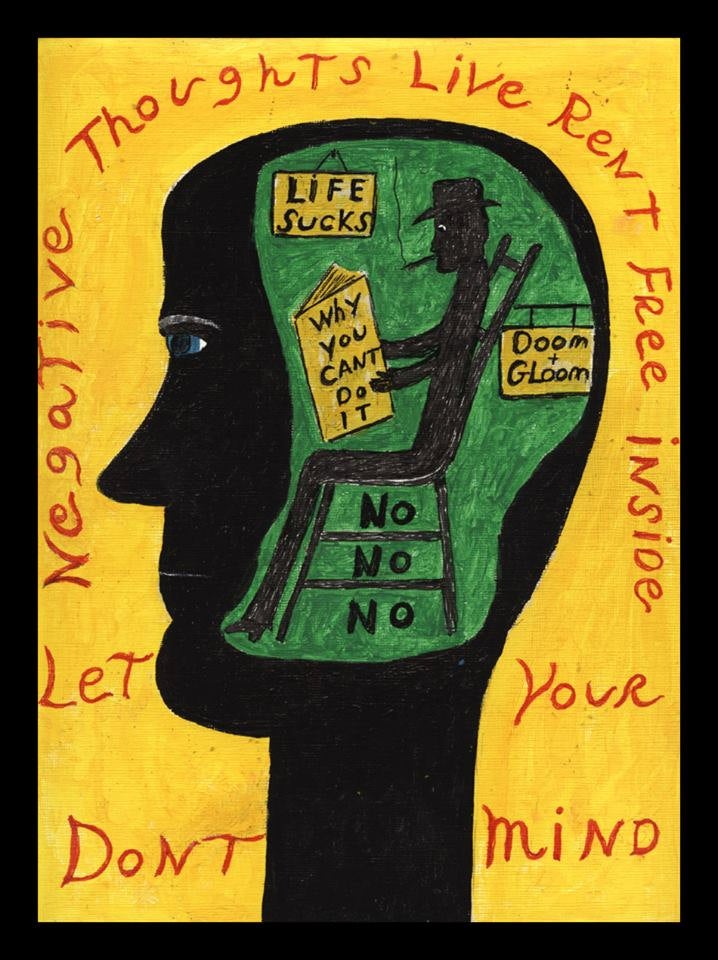
There is a saying about people living rent-free in your head, and how that mental state gives people power and authority over you that is unnecessary and always harmful. As of late, it seems that there are two demons in particular that need to be exorcised from my brain. But before I could do that, I needed to understand why they had taken up residence in there for so long. And so, I present to you, two stories of vague-blogging for your reading pleasure. One, as pertains to work life, and one to theater life. This post will deal with tenant #1 from work. Let’s call him “Spitz”.
Spitz is a well-respected man in his industry. A sports star in his youth, he probably charmed many a lady out of her virtue in school days, and persuaded many a man to follow him, or perhaps even do his bidding. Spitz developed a certain Southern stamina and guise that served him well. He could weave a spell that seemed to entrance everyone around him. Spitz realized this power he possessed would serve him well in business, and quickly rose up the ranks, ever the expert on rhetoric, always convincing people his was the way.
By the time our paths crossed, Spitz was riding a wave of greatness, having just left an organization after completing, what would appear to be, a great victory, not only for himself, but for the company. He swooped into the company I was working for, on a crusade to save the business and its owners from what seemed certain destruction, as the work was coming in, but the infrastructure could not handle the load, and the foundations were beginning to show stress fractures.
Spitz was hired initially to provide focus and direction, but after working with him a few weeks, it seemed very clear to me that his vision of my role was to support him in endeavors outside of the scope of not only my experience, but my understanding. Additionally, I was to do all the detail work, so Spitz could take the credit. The first time I met him, I didn’t see this suave executive; I merely saw the equivalent of a used car salesman. And, having worked with my fair share of people with this penchant, I immediately knew this would be trouble.
“An entire sea of water can’t sink a ship unless it gets inside the ship. Similarly, the negativity of the world can’t put you down unless you allow it to get inside you.”
Goi Nasu
What I didn’t know was how miserable Spitz would make me for the next 6 years. We clashed so much in the first few months that they actually hired someone else to manage me, and to do the things for this person that I simply was not equipped to do, so our paths would be somewhat separate. (This may be over-thinking on my part, and the reasons may actually be more than just me, but this narrative suits the tale).
This new person had history with Spitz, and understood and accepted his way of doing things. And for a time, it was bearable. And she really did try to make things better. And they were, in a way. But Spitz’s requests and expectations were so obtuse, I felt myself scanning the horizon many a time, looking for an out, so I could begin my journey elsewhere.
My struggle with jumping ship was racked with fear and doubt: finally I had a job and a path that allowed me certain creature comforts (flexible hours, working from home, WORKING FROM HOME) that I was just not willing to give up. And so, I persevered. I put my head down, worked even harder than before, kept trying to do everything asked of me, and more, and tried to block out how insignificant and ineffective I felt at my job, and how stuck I felt in the cogs of the company. But Spitz had a way of speaking that, while sounding like charm and flattery on the outside, made you feel little and unworthy on the inside.
Then, in December of 2016, an amazing thing happened. A portion of my company was sold to a larger company in the industry, and we would be integrated onto their existing infrastructure. I believe Spitz was instrumental in this acquisition, and had, in fact, been planning this since he began at this company. This was his victory.
I was assured that my job was safe, and that my merit had been communicated to the new powers that be, and that I would be working with a larger team of people who did what I did. I was cautiously optimistic. The only sad part was that the person hired to manage me would be moving onto another role in the new company, as her position was redundant in the new organization.
And, for a time, it was better. And they did, in fact, communicate positive things about me into the new organization. My new boss was a breath of fresh air. She was kind, and encouraging, and nourishing, and made me feel like it was possible to do more, understand more, expand my abilities, and grow. But Spitz was always lurking in the shadows. No longer a direct report, a bigger buffer was placed between us, but he still managed to push the boundaries of the new company’s credo to get things he wanted, and at the cost of my workload, and still managed to take up residence in my head, even though our paths were not as direct. And though my dealings with him were less and less, I always sucked in a breath when an email would come in from him, or a Skype message would pop up on my screen. I would physically recoil and think: he’s going to do or say something and I won’t be able to handle it.
Over the years, I still deal with Spitz, but to a lesser degree. And, I have had several bosses since the acquisition – each with their own set of communication skills. But Spitz still lurks in the corners. And when we have exchanges, I feel my whole body becoming rigid, ready for the fight. My current boss told me recently that Spitz is a “trigger”, and that I seem to always deal with him in a defensive, and somewhat hostile manner, and that I need to try to learn how to work with him, not against him.
I recently read Alan Alda’s book, “If I understood You, Would I have This Look on my Face?”. It’s a lovely read about his life’s work in communication; both theatrically, and in his endeavors to teach scientists to be better communicators. And one of the the nuggets of wisdom he imparts from his days of doing improv in his youth is the practice of “Yes, and…“. This allows you to work with, rather than against, the ideas of the person with whom you are communicating, so that the integrity of the original ask is kept, while allowing you to expand upon this with your own input. It encourages you to listen and be receptive to the ideas of others, rather than immediately judging the idea. This circumstance with Spitz seems like a very practical circumstance to try this theory out. And so, this is what I will try to do over the course of 2020.
So, will this new way of thinking help exorcise Spitz from living rent-free in my head? Only time will tell. But just as this one demon lives in my work space, there is another living much more subtly in the crevices of my theater mind. And I had no idea he still lived there until recently. But that is a tale for another post.
“Letting go of negative people doesn’t mean you hate them. It just means that you love yourselfDon’t let negative and toxic people rent space in your head. Raise the rent and kick them out.”
In the wake of the recent news about Kobe Bryant and his daughter, one cannot help but feel utter sadness and loss for that innocent child. And yet, my feelings about the outpouring of sympathy and sorrow for Kobe himself are mixed. Obviously, it is always a tragedy when someone dies, but have we all forgotten the sexual assault allegations from 2003? Why do we, as human, sweep the bad under the rug, and focus on the good, when a person dies? Is that the human thing to do? Is it the right thing to do?
Courtesy of David Balyeat photography
Take Michael Jackson as another example. Venerated in death, we heard little posthumously about his predilections towards young children and questionable behavior as a parent dangling his son off a balcony.
I am torn by focusing on the actions we take throughout the entirety of our lives, and the legacy we leave behind upon our death. Of course, we would all like to be remembered as a good person, but if one has committed heinous acts against others, should we ignore those in our remembrance after we die?
Taking a step back: how does one sum up the total of their thoughts and actions after one has passed? Do we look at the breadth of deeds, or edit to just those parts we wish to bring forth?
I wish I could say that, up until this point, my life and action have been beyond reproach. That I have been a model citizen, and without question. But I have not. I think I try my best, as often as I can. But I am not perfect. I am flawed, and unique. And maybe it is exactly that combination of attempt and shortcomings that define my existence on this earth.
A few years ago, as part of a workshop for my company and its leadership series, I was asked to write my own eulogy. More of an evaluation of perception that an accounting of the good and bad, it did two things: provide a startling reminder of my own mortality, as well as give me perspective on what the world might perceive of me, rather than what my intention had been.
Sadly, I cannot locate the piece of writing. But perhaps it might be a valuable exercise for each of us to perform, once, maybe many times, to provide a reality check as to whether we are, indeed, living our best lives. A way to inform what others will say about us when we have passed, and can no longer defend our honor.
“…it does not matter if we are forgotten; what matters is the effect we have on those around us and those who come after us. What matters is how our own lives affect the larger, perpetual community of the living.”
When I was a teenager, I used to pretend that there was a movie crew following me around. I had it all storyboarded in my head.
Close up: elevator doors, closed. Sound of the elevator ding, car arriving. Cue music (Joan Jett’s “Crimson and Clover“). As song begins, elevator doors slide open and Lee walks out.
Song continues under the following:
Cut to: Lee walks through lobby doors of apartment, past the doorman, who waves good morning to her. She shrugs her teenage angsty shrug and continues to walk down the sidewalk. When she gets to the corner, she looks behind her, then, certain that she is “in the clear”, pulls out a pack of Marlboros from her Army/Navy jacket, shakes one out, and lights it with her antique find Zippo lighter.
(Hey, it was the 80’s ok?)
Lee crosses the street, and continues to walk/smoke to the bus stop, where she stands, alone, watching the traffic and people rushing to work, a smile on her face. A yellow school bus arrives, and she flicks her lit cigarette into the street, pops an unlit cigarette strategically behind her ear, takes a big breath, turns her face into a scowl, and climbs onto the bus.
Cut to: School bus on Major Deegan (song by now is in full swing). Montage of bus driving on highways, tunnels, etc.
Cut to: exterior of bus, closeup on window with Lee’s face pressed against the glass, looking glum. Behind her, in the bus, pan left to right on usual teenage antics: Couple of preppy boys in Izod polos wearing pooka shell necklaces looking at a Playboy magazine, girls with high pony tails and multiple day glo bracelets ogling at the cute boys in front of them, giggling; stoners behind them, taking hits off a RUSH bottle, and finally, in the back seat, one kid stretched out, snoring and farting.
Cut to: school bus pulls into high school, and circles the off -road driveway, song fading. Kids disembark, with Lee exiting next to last, who looks around, recognizes someone, pulls the previously placed cigarette from her ear, lights it, makes a “s’up” head gesture, and saunters off camera. There is a pause, then we hear the bus driver yelling, and a befuddled and disheveled previously sleeping kid darts off the bus.
I replayed this opening scene every morning of my sophomore year of high school, honing and refining the images until I was satisfied. Joan Jett’s song was always a constant, as was the opening with the ding of the elevator. But the rest evolved over time.
Each time I replayed it, I would imaging a crew of people following me, walking backwards in front of me, laden with equipment. We never did a “second take” in the same day. We had to wait until the next morning to try again. And, astonishingly enough, no one ever saw the crew around me. Only me.
Sometimes the crew followed me down the halls of the school; sometimes into Central Park on the weekends with my friends, where we would have “shenanigans” that involved some mildly illegal substances, and the statue of Alice in Wonderland.
But this fantasy, if you want to call it that, was my constant companion that second year in high school. I never shared it with anyone, ever, until this post today.
I’ve been thinking about that year, and that rather indulgent fantasy life I was living that year. I was extremely lonely and depressed – I had yet to find my posse of people in school, and I was a mass of hormones and doubts, and needed an outlet where I could be someone other than myself.
I think it was in that year that I was mentally grooming myself to be an actor. I had no previous acting experience, never had much interest in much of anything. And it wasn’t the idea of “becoming someone else” that kept that fantasy alive that year. It was the serenity of that group of people constantly walking with me through every shoot: the gaffer, the boom operator, the camera guy… that made me feel less alone. I never fantasized conversation with these people, but knowing they were always there, always ready to “get my back”, that gave me enormous comfort.
Looking back, I think that’s the thing I like most about film and theater – the community of people that it takes to make a project happen. The endless hands and eyes and brains and feet of people who are all focused on a common goal; which no one person can single-handedly accomplish.
Today, I could never say that any one team or company that I have worked for has given me the same feeling as any theater production or film project has done. Work teams do work together, but they seem very disjointed and unemotional, and I don’t get the sense of community pride in the completion of something. Because nothing is ever really complete at work. It’s just another day or something else, that culminates in nothing tangible, save a paycheck.
I miss my teenage film crew. But I believe I have been rewarded over and over again by the many teams I have been part of so far in film and live theater. And hey, maybe someone will take my teenage fantasy and make it into a real movie some day.
Yeah (smiles at the camera, and tucks a cigarette behind her ear, as she heads upstairs for another cup of tea).
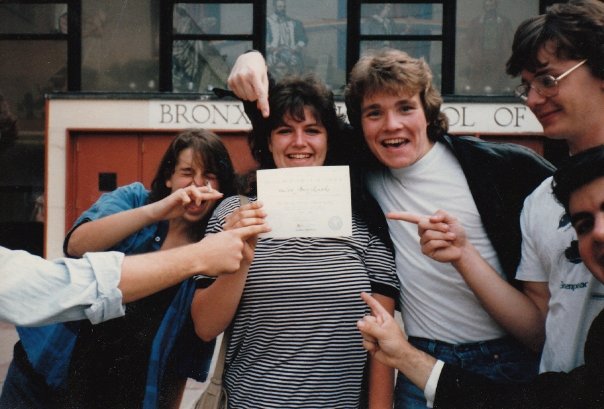
That’s me, with my posse, proudly showing my high school diploma, May 1986
Post note: that lovely kid to the right of me in the photo above was one of “The Scoundrels” – the posse I hitched my wagon up to in high school. His name was John Gargan. Sadly, he passed away in early January 2020. RIP, my friend.








 Minerva's Manor