Gratitude Video Series #4: Nora Eschenheimer

Creating this series of blog/vlog posts has been an absolute pleasure for me. Taking these moments to not only remind myself of the wonderful people I have encountered in my life, but also sharing them with the universe, has been such a positive force in creating a “next chapter” in this personal shift.

Today’s gratitude video was inspired by the Friday Lunch-time Gamm Theatre YouTube series “Brush Up Your Shakespeare” with Artistic Director Tony Estrella. His guest this Friday was Nora Eschenheimer. Watching her for 60 minutes inspired me to dedicate an episode of my own to her. She is a bright light and benevolent force of nature, and you should all be lucky enough to meet her, or even see her work, either in person, or virtually. (and, if you haven’t, check out these videos of her).

I give you: Nora Eschenheimer!

Do you have someone you would like to express your gratitude to? Send me a message, and let’s talk!

Gratitude Video Series #3: Wendy Overly

I have had some amazing feedback with regard to this gratitude video series, so first and foremost, thank you so much for your comments, likes, shares, and all the interactions from this.

So far, I have paid tribute to two amazing humans, Richard Wilber and Jen Reading. Well, today is no exception. Today, I want to share a little history and A LOT of accolades for one of the most amazing women I know. From crafting, to mother and grandmother, actor, director and vocal coach, she is a powerhouse and a truly positive force. But, most importantly, she is an incredible friend, and a loving, kind, amazing human being. I give you: Wendy Overly.

Gratitude Vlog #3: Wendy Overly

Do you have someone you would like to express your gratitude to? Send me a message, and let’s talk!

Gratitude Video Series #2: Jen Reading

In my last post, I began the first in a series of video blogs, or vlogs, dedicating my gratitude and love for a very special person in my life: Richard Wilber.

In the next post of the series, I wanted to focus on an elementary school friend; a woman who helped create the foundation of the person that I am today. Jennifer Reading.

Do you have someone you would like to express your gratitude to? Send me a message, and let’s talk!

Gratitude Video Series: #1 Richard Wilber

A while back I wrote a post about gratitude, and about how difficult it was for me to accept a compliment. After writing that post, I thought it would be an interesting experiment to do a series of posts, where I would express my gratitude to various people in my life.

Then I thought, maybe, instead of posts, I could do a video series. And, thus, the seed of an idea was planted. Today, I present to you the first of hopefully many gratitude videos. My first recipient: a man I have know for decades, and a wonderful teacher, performer and friend. I give you Richard Wilber:

Gratitude vlog #1: Richard Wilber

Do you have someone you would like to express your gratitude to? Send me a message, and let’s talk!

An interview with myself: asking the tough questions, part 2

About three weeks ago, I asked myself some tough questions about confinement, and endless purchasing from Amazon. Today I’ve decided to delve a little deeper into the tough questions. Why today of all days? Well, today is Easter, and the third day of Passover. And these solemn religious holidays seemed an especially appropriate to delve into my own psyche, root around, and see what surfaces.

  1. What am I really grateful for?

Interesting question, and pretty timely. In my last post I mentioned I am taking an online class through Yale University on “The Science of Well-Being”. In this class, one of the homework projects was to start a daily gratitude journal. Just five simple things, on this day, you are grateful for. I say interesting because, prior to this pandemic, I think I would have been grateful for much more materialistic things; my summer home, my car, my ability to eat out whenever I want and not have to check my checkbook first. But one of the fascinating things I have found about being confined and bombarded with danger and warning all over media (mass and social) is how very basic my daily list has been since I started this exercise about 12 days ago. There is very little variation, except in the order, and seem to come down to five basic things:

  • Health
  • Companionship
  • Having a very comfortable place to shelter and wait out this virus
  • An abundance and variety of food at the ready
  • The ability to connect with people on the outside

So it seems, when faced with extreme challenges, we revert to the basic human needs: Food, shelter, companionship and connection. I hope to hang onto these things, even after the pandemic is over.

2. What am I afraid of?

This is a difficult one to articulate, but again, something I have been able to think a great deal about. But I came to this understanding by first thinking about what gives me comfort. And, over and over again, I return to one thing: certainty. I like knowing and understanding things. I’m constantly seeking to learn new things, to understand certain concepts deeper. So, it stands to reason that uncertainty is what I fear most. I combat this with the act of seeking knowledge.

But what happens when you just simply can’t know? For example, one of the main reasons I never had a child (and there are soooooo many reasons – hosts of reasons) but the boiled down reason is: I didn’t know what that would feel like, would do to my body, would change my life. And so, as much as I could read and ask questions, it scared me too much. So I didn’t do it.

Like my need for knee surgery. I’ve asked countless people who have had knee replacement what it feels like, what honestly happens and what goes on afterward. But I still don’t know how it would be for me. And so I put it off.

Like this virus. I can’t see it, the world doesn’t understand it. We don’t have answers, yet. And we can’t stop it. We can cut off it’s supply of “food”, but we are uncertain. And we don’t know if we are coming in contact with it, or, indeed, if we have already come in contact, and if we have, if we will be sick, or not, or die. And so I fear it because I cannot see it, and I don’t understand it.

Like death. I admire people with faith who believe there is a heaven, or a rebirth, or a collective consciousness after, THIS. But no one has put this down as a scientific fact, or irrefutable knowledge, and everyone believes something different. And so I fear it, because I do not know.

So, what am I afraid of? Of the unknown: Pain, suffering, and death. And childbirth. Final answer.

So, I am grateful for the simple things and afraid on the unknown. I think that’s enough deep thinking for one day.

What are you grateful for? What are you afraid of?

Hedonic Adaptation- good news in a pandemic?

Three weeks ago, when we had just started quarantining the US at home, I decided to take a free course offered by Yale University on “The Science of Well-Being“. It came up in my Facebook feed on a friend’s post, and I thought, “why not?” I mean, it’s not exactly the pinnacle of my social calendar at the moment. That, coupled with the fact that 2020 has been, by choice or by circumstance, a year of looking inward, I thought this would be a nice complement to this work.

In one of the lectures in week 3, they discuss a concept called hedonic adaptation, or hedonic treadmill. Basically, the idea is that there will be many circumstances in your life that are extreme positives or negatives. But, as humans, we tend to revert to a relatively stable level of happiness after these events occur.

So, for example, let’s say you just landed the job of your dreams. In that instant of learning, your happiness ratchets up to the stratosphere. Fast forward to the second year in that same job, and most likely, your happiness level is closer to the level it had been prior to receiving the news (but hopefully a bit higher) than the level it achieved at the moment of learning you got the job. Sad news for all those joyful occasions in our lives, right?

But it got me thinking. This concept works for both positive and negative circumstances. Which got me pondering our current pandemic situation. I think it is fair to say that many of us are experiencing a very low level of happiness right now, especially because there is so much that is unknown:

  • Am I going to get the corona virus? If I do, will I get very sick and die?
  • Did/do I have the corona virus? If I do/did, have I unknowingly infected others?
  • When will this end? When will be able to get back to normal

So, in the case of extreme negative feelings and circumstances, can we take solace in the notion that, at some point in the future, hedonic adaptation will allow us as humans to return to a higher level of happiness than the state we currently find ourselves in? If we have developed some good habits (and many, many, bad habits- read 20 extra pounds) could the continuation of the good habits (daily meditation, mindfulness, yoga, gratitude) raise that level of normality to a slight better than average happy when this is over? Or will the scars of this event weigh heavily on us, and reduce our “normal happy” to a substandard of what once was?

Most days I’m pretty ok. I still have my job, which has always been in a home office, so the 9-5, M-F for me hasn’t changed much. But, I’m no hero. There are days (yesterday was a doozy) where I feel completely overwhelmed by the situation, and overcome by the anxiety and paranoia of not knowing and being able to see “the enemy”. And I worry because my husband is out of work right now. And I worry that, if this continues, I may lose my job. And it’s a huge tsunami of feels. It’s paralyzing.

The good news is, if the data tell us anything, it’s that we will all recover a relative sameness to our happiness when this is behind us. Some less so than others, some more. But it demonstrates something that I have been reminded of every day during this crisis. It is the resiliency of the human spirit to want to be happy, and to “find the helpers” and “look for the good”, even in the darkest times.

What do you think?

Kipling, Coronavirus and Buddha

I am an avid reader. Sometimes for escapism, sometimes for education, or a thrill, or to connect with someone more deeply by learning about their past. I have not, however, been a big reader of poetry. Sure, I like some of the obvious poets: Shakespeare, Eliot, Frost, Poe. But, for a great deal of poetry, it’s always felt like Jazz Fusion.

Let me explain. I love music, specifically jazz. It is, perhaps, my favorite genre of music. But jazz fusion seems too abstract, makes me think too much, try too much to stay with the piece. Like jazz fusion, with poetry I find myself needing to fill in pieces of the narrative, when I would rather just consume it. Just my opinion.

So, reading=music as poetry=jazz fusion.

However, at a young and impressionable age, I was introduced to the stories and poems of Rudyard Kipling. And his poem, “If” struck such a cord in me, and, has since stuck with me as one of the most profound and simply beautiful poems. It also parallels many Buddhist tenets, which I never noticed until recently. For those who may not have read it, or don’t recall it, here it is:

If

If you can keep your head when all about you   
    Are losing theirs and blaming it on you,   
If you can trust yourself when all men doubt you,
    But make allowance for their doubting too;   
If you can wait and not be tired by waiting,
    Or being lied about, don’t deal in lies,
Or being hated, don’t give way to hating,
    And yet don’t look too good, nor talk too wise:

If you can dream—and not make dreams your master;   
    If you can think—and not make thoughts your aim;   
If you can meet with Triumph and Disaster
    And treat those two impostors just the same;   
If you can bear to hear the truth you’ve spoken
    Twisted by knaves to make a trap for fools,
Or watch the things you gave your life to, broken,
    And stoop and build ’em up with worn-out tools:

If you can make one heap of all your winnings
    And risk it on one turn of pitch-and-toss,
And lose, and start again at your beginnings
    And never breathe a word about your loss;
If you can force your heart and nerve and sinew
    To serve your turn long after they are gone,   
And so hold on when there is nothing in you
    Except the Will which says to them: ‘Hold on!’

If you can talk with crowds and keep your virtue,   
    Or walk with Kings—nor lose the common touch,
If neither foes nor loving friends can hurt you,
    If all men count with you, but none too much;
If you can fill the unforgiving minute
    With sixty seconds’ worth of distance run,   
Yours is the Earth and everything that’s in it,   
    And—which is more—you’ll be a Man, my son!

Upon first blush, it has some echoes of a time before now, and a rather masculine viewpoint. However, he was writing what he knew: he was a man, and it was a letter of inspiration, of sorts, to his son. But what I love about it is how, with each stanza, it’s such an amazing universal tip for us all. Perhaps, especially now.

Kipling teaches us to be mindful of ourselves from the inside out. The first stanza is very similar to the buddhist teachings of controlling our minds and how we react to external circumstances which we cannot control. It also talks about having empathy, which is something that is so lacking in culture, but for which this whole “stay at home” order is fundamentally based.

The second stanza starts looking outward, at our actions in the world, and how they affect our self-worth. It, and stanza three, speak to another buddhist tenet: that of impermanence. But the end of the third, it seems, is so incredibly relevant to what, I think, so many of us are feeling right now:

If you can force your heart and nerve and sinew
    To serve your turn long after they are gone,   
And so hold on when there is nothing in you
    Except the Will which says to them: ‘Hold on!’

There are some dire circumstances going on in the world. I’m not telling you anything you don’t know. But how amazing and wonderful is the human spirit, even in adversity, to just “hold on” knowing that, while things may not go back to “normal”, that they will change, and they will get better, even if better is something new.

The final stanza cautions the reader about the concept of attachment, and to stay true to oneself. It summarizes the teachings of the poem into a simple list – stay humble, compassionate, mindful, and thankful.

Literature is a wonderful place to contemplate the world, and our innermost thoughts. And, this poem provides a beacon of hope, and a guide to mindfulness, for this humble reader.

The Mother Chronicles- a lesson in compassion?

Last week, amid all of this Corona mania, I called my mother to check on her, and see how she was doing. She answered the call, sounding distracted, and told me she couldn’t talk to me because she was at the hairdressers.

And then she hung up on me.

I called her later, to fill her in on some information regarding her estate paperwork, and then chided her for risking her health, all to get her hair dyed. I told her if she needed anything, anything at all, she should call me and I would get it for her, and bring it to her. She reacted like a petulant child, and, in a sing-songy voice said, “Sorry MOM!”

And then she hung up on me. Again.

So, I haven’t called her in about a week, doing some psychological punishing for her actions.

This afternoon, at 5:04pm, me phone rings. I look and it says, “Irene Rush”.

Instantly my eyes begin their involuntary eye roll, but I answer, concerned (as always) that something might be wrong.

The first thing she says is, “I’m fine. BUT, I need you to go shopping for me. I got the Stop & Shop flier and have a list based on the sale items.”

To which I calmly (ok, maybe not so calmly) reply, “there probably aren’t going to BE any sale items. We are in a bit of a demand crisis lately.”

She ignores me, and proceeds to give me a very specific brand and SIZE list of what she needs at the store.

I say to her, “ok, but they may not have exactly what you want. Is there a substitute in case they don’t have these things?”

To which she replies, “It’s on the flier. Why wouldn’t they have it?”

By now, I have begun to pour a gigantic glass of wine.

So, we go through the list, and she gives me substitutions, or, alternatively, orders of what to “forget about, if they don’t have <EXACTLY THIS THING>”.

So, trying to be helpful, and, knowing I have an abundance of fresh produce (which she has not included as any EXACT THING on her list) I ask her if she could use any of the things I have in my fridge. I don’t tell her it’s in my fridge, but figure maybe she might add some fresh items (besides Campari tomatoes “which are buy one get one free, but I only want one” and iceberg lettuce

“how about romaine mom, iceberg is just water?”.

“If I wanted romaine I would have ASKED for romaine.”)

Her response was to go into a diatribe abut how the Chinese should be punished for infecting the world with their filthy disease, and now they are going to profit from our demand for certain items and gouge us.

I take a big gulp of my pinot.

Then I say, calmly (really, really trying to be calm now) “Mom, how did we go from daikon radishes to the scourge that China brought to the US?”

To which she replied, “oh, I guess I should have signaled before I turned. So, your Uncle called to tell me so-and-so just died…” and went on to tell me about relatives who I have no clue who they are to have sadly passed.

I stopped listening at this point and took a big swig of pinot noir.

I let her continue, inserting encouraging sounds where it felt needed, starting to gather the ingredients for the lasagna I planned on making for dinner.

She stops talking, so I say, “hey can I bring you some lasagna tomorrow with your groceries?”

She replies, incredulously, “Are YOU making lasagna???”

I pause, sip and say, “yes, I am. I was just about to start cooking.”

She pauses (not to sip, she doesn’t drink alcohol, I assure you) and says, “That would be fine.”

We exchange pleasantries, and I hang up. I sit at the dining room table, inhale and exhale deeply for a few breaths, and take another slug of wine.

And then I think about what just happened.

  • I did ask her to call me if she needed anything.
  • She didn’t go out herself to purchase everything.
  • She lives alone and probably is going a little stir crazy.

So, I asked myself:

  • Why do I feel so put out whenever she calls?
  • Why does she so easily push my buttons?
  • Why does she act so defiant and pushy? What does she really feel?

My mother has a habit of alienating everyone around her by telling them what she believes they are doing wrong, and what she things they should do, and why she is right. She does this to me, to her own brother, to her friends, her own doctor. She used to do it to co-workers.

My mantra has always been “I NEVER want to be my mother. I want to be kind and compassionate. I never want to have children and do this to them.”

(I could go into a whole years worth of therapy sessions now, but let’s leave it at that.)

According to the dogma I learned at the meditation center I used to frequent, difficult people are opportunities to understand ourselves better. To learn how to be compassionate to everyone, no matter what.

Maybe, in a strange way, she is my teacher. She is my opportunity to be compassionate, to be a better person, to love despite the pain.
An interview with myself- asking the tough questions: part 1

Ok, I’ll admit it. Spending day after day confined in my house isn’t that big of a change from my normal day to day. As a telecommuter, my weekdays haven’t changed. What has changed is that I am no longer alone on weekdays, as I sit and listen to my other half sighing with frustration and boredom during his work furlough.

So, we find ways to amuse ourselves, right? I decided to ask myself some hard questions, and write my answers as a series of blog posts. The answers are truthful, if somewhat long-winded (Lee? Long-winded?? Never!!). This first part contains the easier questions. I’ll save the harder ones for future posts.

  1. Why do I buy so much from Amazon?
    You know, this is a subject that has been weighing on my mind a great deal, as of late. BC (“Before Corona”) my shopping habits were filled with purchased based on that mantra of “instant gratification” mixed with intense laziness: I want this book/gadget/thingamajig and I can get it delivered to my door in about 2 days. But did I need any of those things? Some, yes. Dog food, supplements, razor blades, sure. Others, it was the ease of the transaction, coupled with the control of getting it.

    Now, in the DC (“During Corona”) era, my shopping habits are to acquire needed things with the least amount of interaction with others. And the purchases are less frivolous, but more mentally appeasing: electronic books, junk food (ugh, shame on me), batteries, distilled water, a case of tomato sauce. One could say physical and emotional necessities. And, while I chide myself for some of the indulgences (read: shortbread and Hershey’s kisses) I suspect these will pass in the AC (“After Corona”) habits. But we shall have to wait and see when that era comes to pass.
  2. What have you learned about yourself from being “confined” in your home? About your husband? About others?
    I have discovered that I am very very good at keeping myself occupied. As an only child to a single parent growing up in the 70’s and 80’s, I was frequently home alone for long portions of the day. Since I grew up in Manhattan, it wasn’t like I could go outside and play until my mom got home, so I spent a lot of time in our apartment, finding things to stimulate the little grey cells. Back then, I would come home from school, turn on the tv, and turn the volume to a level that was less like conversation, and more like murmuring: creating background noise. I would set up my school books on the dining table, and grab a drink (juice or, more likely, diet pepsi – the drink of choice for my mom) and a snack, then turn on the radio (yep, tv AND radio) and quietly play music while doing my homework. There was a great NPR station that played classical until about 4:30, when it switched over to news, and I switched it off.

    After that, it was either reading a book, or doing a jigsaw puzzle or a word search from the giant book of Word searches my mom would buy from the hospital gift shop after her shift, or, when all else failed, turning up the volume on the tv and trying to find an old black and white movie to watch, or WGBH or WNYC, where hopefully they would have an English show playing. I loved English television. I remember, at a very early age, sitting close the the tv and parroting every line of the original “Upstairs Downstairs” out loud, in the accents. I LOVED English accents. And I was very good at them.

    Sometimes, I would go to my bedroom and play an album while lying on my bed, thinking about what the songwriter meant by those lyrics, or that use of instrument at just that time. As a teenager, my album of choice for almost four years was The Moody Blues “Days of Future Passed“. In my mind’s eye, I saw a full-length feature of visuals for that album, akin of a Fantasia-like quality, but with actual live footage, rather than cartoons. I still see that movie in my mind every time I listen to that album. I would love to lay out my visions for that album and have someone film it.

    Not much has changed in 40 something years. Now confined to my own home, I go downstairs every morning during the week around 7:00am with my cup of tea. I ask Alexa to play either Jazz or Classical, and turn the volume down low. At around 5pm, I come upstairs, grab a glass of wine, or other beverage of choosing, (my adult “snack”) and relax with a Kindle novel, or a jigsaw puzzle, or app on my phone. I might lie on the sofa and listen to a podcast episode, or ask Alexa to shuffle songs from “Yacht Rock” or more Jazz or Classical. Or, I’ll stream an episode of whatever show I’m binge watching on Netflix or Prime on my iPad. And I will troll my social feeds, but not for any length of time.

    I’m not much of a TV watcher anymore, but my streaming preferences still lean towards the anglophile in me. And, yes, I meditate. Once in the morning, and again in the afternoon or evening if I feel the urge. I love to meditate. I prefer a guided meditation, but can also easily sit for 20-30 minutes if there are nature sounds playing (thank GOD I bought a lifetime membership to the Calm app for myself last year. What a worthwhile investment!)

    What I am learning about my husband is that he gets sucked into the vortex of media and has a hard time getting out. He’s not quite as good at amusing himself indoors as I am. But hopefully my actions will rub off a bit. He gets so riled up that I think he’s going to grab his chest and keel over, but he manages to calm down. He reads some, but I think he bores easily.

    What I am beginning to learn more and more about my friends is how tough confinement is for them. I don’t truly understand why, but I am so saddened by how anxious and depressed my friends seem to be. And how afraid. I mean, we’re all afraid, but if we have taken proper precautions, and maintain social distancing, most of us will get through it. I am trying to find more opportunities to spread assurances, and compassion, in the hopes that people don’t feel like trapped animals. But it saddens me greatly how many cries for help I read in my feeds.

    This is an ongoing discovery. Every day there are more and more awakenings that I am finding. But this is as it stands after about two weeks of social distancing.

What have you learned about yourself and others in this different time?

Next time: more tough questions, and my answers.

Faith, Religion and Meditation

What is faith? According to Wikipedia it is “confidence or trust in a person, thing, or concept. In the context of religion, one can define faith as confidence or trust in a particular system of religious belief. Religious people often think of faith as confidence based on a perceived degree of warrant, while others who are more skeptical of religion tend to think of faith as simply belief without evidence.”

So, is faith always assigned to religion, or can one broaden the definition to any concept, or perhaps practice, habit or routine?

I’ve always been a staunch opponent to organized religion, having once been accidentally saved by the Greek Orthodox church on a strange weekend with my cousin when I was a child of about 8 or 9 (a story for another day). Then there was the time I inadvertently participated in as EST meeting with my friend and her dad in junior high school (oooh, so many stories I could tell). Even to my upbringing in the Jewish religion, the doctrines were seemingly forced down our young, impressionable throats, not about God and demonstrating to us impressionable, young children examples of faith, but rather force-fed the atrocities of the holocaust (“6 million Jews!“) for almost a decade, until we were left either traumatized by the information, or, like myself, strangely detached and numb to it all, as if it were just data in a textbook (probably still a form of coping due to trauma).

But what about those grey areas that are somewhat religion-y, and somewhat a ritual? For example, I have been dabbling in a meditation practice for over a decade. Like anything good for you, I found, with regular practice, I did actually feel better. It wasn’t as noisy in my head all the time, making lists, weighing risks, playing out what-if scenarios. But not only were the results felt mentally and emotionally: I was actually able to take the edge off my physical pain. Not stop it completely, but make it manageable. And, with this revelation of fact based evidence, I began to believe in meditation.

So now, in the past year or so, I practice meditation daily. It has definitely aided in my overall positive outlook on life. I’m less “judgy” of people, or of circumstances. I’m more compassionate. Even in the midst of this COVID-19 outbreak, I am able to look at things in a much more calm and rational way. I don’t worry as much about the big-picture stuff. I focus on my actions and how they impact myself and others.

So, is this belief in the benefits of meditation considered faith? Or is it just a positive habit I have trained myself into performing on a daily basis. If we go back to the definition above “confidence based on a perceived degree of warrant”, then, yes, I have faith in meditation. In how it improves my outlook, in how it provides the mind benefits, both mentally and physically.

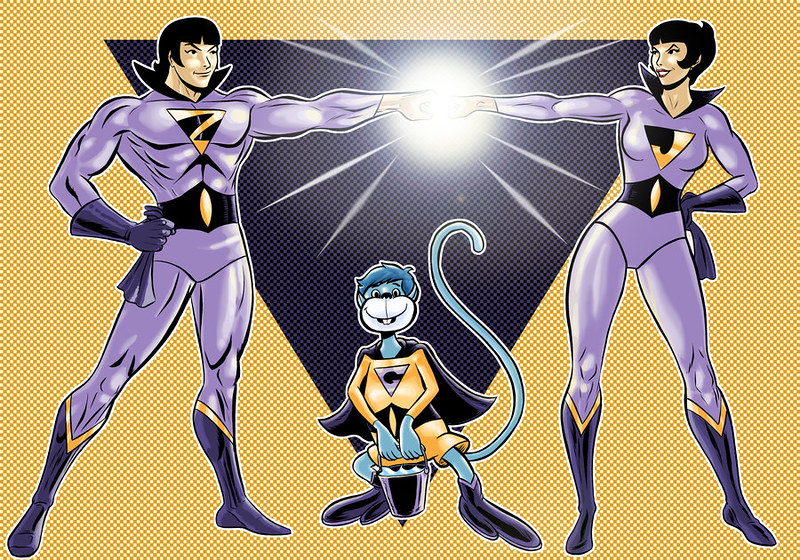
But whenever the meditation teachings start taking about Buddhas and past lives and future lives, and people transforming into birds and waterfalls like the Wonder Twins, I feel myself pulling away from it. In my logical brain, I understand these parables are meant to convey greater meaning, and not meant to be actual historic events, but any time it gets less tangible, and more… “wuwu” I need to step out.

The wonder twins were actually my favorite super heroes. The idea of being able to turn into any form of water was incredibly exciting to me. I don’t remember how the monkey played into the scenario, though.

So, dialing it back into the circumstances of our new world order, I have faith that the majority of us will get through this outbreak, that this will be a footnote in our history books. And I hope we will have all used this time to spend time with loved ones in our homes; to reconnect and get the know each other again. More importantly, I hope we come to understand ourselves as kind, loving, compassionate people who took actions which may seem to have made no difference in the end, but have saved many precarious lives, had we not taken these measures.